
There’s no set deadline in Louisiana, but it’s best to start early. The longer you wait, the harder it gets to gather documents, pay bills, or manage the estate.
Call For A Consultation
Call For A Consultation
 Handling a loved one’s estate after their passing can be an emotionally draining process. Louisiana’s succession laws require diligent planning and execution. Without legal representation from a knowledgeable attorney, beneficiaries and heirs may have to contend with unnecessary delays and financial complications. A Metairie succession and probate lawyer can provide essential support for those navigating Louisiana’s succession laws.
At WJ Blanchard Law, we assist families with succession planning, estate administration, and representation for legal disputes that arise during the succession process. Our experienced succession attorney ensures that your loved one’s estate is handled efficiently and in compliance with Louisiana law.
Contact our office today at (504) 313-7478 to discuss your succession and estate planning needs.
5 STARS – Wills, Trusts, Powers of Attorney and any other customized Estate Planning!!! Also Corporation Set Up! Very professional, knowledgeable, thorough and caring. Consistently excellent, timely results. Can’t say enough about Wes. Thanks for all you’ve done for us.
My Husband and I had Wes create our Wills. His attention to the details and knowledge were spot on. He also handled a Power of Attorney and a Succession for our family. Wes gave us peace of mind that everything would be done professionally and correctly.
Very knowledgeable, courteous, and friendly staff who made estate planning a pleasant experience. Recommend very highly!
Wesley Blanchard is the best! They created an LLC for me in no time and gave me the reassurance I needed throughout the process. They made sure I was informed of the decisions we were making and are the best in the business!
Wes was extremely courteous, responsive, and thorough. He showed genuine care for our needs and made sure things were handled exactly how we expected. I would highly recommend to anyone with needs, whether simple or complex.
I started my journey to accomplish mine and my wife’s Trust 8 years ago but just could never find an attorney I felt comfortable with…..Then we set up an appointment with Wes and that was it……2 months later and our trust was complete…..I’m a very detailed and Wes allowed me all the questions and changes I wanted in our trust and I never felt like he was bothered with the changes ….So patient and accommodating……not to mention knowledgeable…..Many thanks to Rachel for organizing all our meetings……
Wesley Blanchard was very professional and easy to work with throughout the duration of multiple affairs (succession, estate, business, etc.). He was knowledgeable, highly responsive, and made the entire process so easy. We highly recommend him!
It was a very pleasant experience with Wes having our Living Trust made. He walked us through the process and everything was to our understanding. We certainly recommend Wes for all your needs. Thank you Wes.
Mr. Blanchard is simply the best. He handled my succession case in the most professional manner and even answered my questions very quickly after 2 1/2 years! I will be using his expertise in the future, and I would highly recommend him to everyone!
Succession is the legal process of transferring a deceased person’s assets and property to their heirs and beneficiaries. Louisiana law governs the administration of estates within the succession and probate process. Unlike other states that have separate probate courts, Louisiana succession proceedings are handled through district courts. Successions can be classified into two main categories:
Louisiana’s succession laws can be complicated to understand and even more difficult to work through. Many estate administrators turn to a succession and probate attorney for guidance through the succession process, and to confirm that the estate is handled within the requirements of law.
Probate (or succession) can be time-consuming, expensive, and emotionally draining. Fortunately, there are legal strategies that allow you to avoid it, especially if you plan.
Here are the most effective ways to bypass probate in Louisiana:
 The succession process in Louisiana is complicated, but there are several steps that are common to all estate proceedings.
The succession process can be time-consuming, but careful planning and legal guidance can streamline the process. With the right approach, succession can be administered quickly and managed in a way that honors the wishes of the deceased while protecting the interests of heirs and beneficiaries.
Planning for succession is an integral part of estate planning. A succession attorney can help you put together an approach that ensures a smooth transfer of wealth to your heirs. On the other hand, without a clear estate plan, your family could be left having to hire lawyers to dispute their differences in court.
While estate planning involves drafting wills, setting up trusts, and establishing a comprehensive plan that is tailored to your needs and goals, the guidance of a succession and probate attorney can assist beneficiaries with minimizing tax burdens and avoiding unnecessary delays that could cause financial hardships for your family.
 A simple succession is a streamlined legal process for transferring a deceased person’s assets. It’s available in certain cases where the estate is small, straightforward, or uncontested. Louisiana law allows for this simplified process to reduce legal expenses and avoid the delays of full probate.
A simple succession may be possible if:
In most simple succession cases, heirs or a Metairie succession attorney can file an affidavit or petition with the court to transfer ownership of the assets. There’s typically no need for a full court administration, and the process can often be completed quickly.
For example, if a parent passes away, leaving only a bank account and a vehicle, and all children agree on who gets what, a simple succession can be used to transfer those assets legally without a full probate case.
An executor is responsible for managing the estate, ensuring debts are paid, and assets are distributed according to the Decedent’s Will. An administrator serves in the same capacity in the event the estate is handled under intestate laws, when the Decedent did not have a Will. In both instances, this role requires handling financial records, seeking out relevant information about estate assets, and addressing disputes among heirs.
Executors are expected to act in the estate’s best interests. This effectively means they need to have a firm understanding of Louisiana’s succession laws or access to an attorney who does. The Will typically names the executor. If there is no will, the courts can appoint an heir can petition to be appointed an administrator, and will perform many of the same basic duties.

In most cases, the executor is someone named in the person’s will… often a spouse, adult child, or trusted friend. If there’s no will, or the named executor can’t serve, someone else can step up and ask the court to be appointed. That might be a family member, an heir, or even a creditor. The court has the final say, but it’s common for someone close to the deceased to take on the role.
Yes, a will can name multiple people to serve together as co-executors. While it’s allowed, having more than one person in charge can make things a bit more complicated since they’ll need to make joint decisions and sign everything together. Because of this, some people choose to name one main executor and a backup, just in case.
Yes. Louisiana law allows executors to receive a fee for their work, usually 2.5% of the total estate value. If the will sets a different amount, that’s what applies. This compensation is paid from the estate, not out of the executor’s pocket.
If an heir can’t be located, the executor is expected to make a real effort to find them. That could mean reaching out to family, searching public records, or using a professional locator service. If the person still can’t be found, the court might allow the estate to move forward anyway. The missing heir’s share can be held by the court or managed through a special process until they’re located or declared legally absent.
Even when you plan for the future, these challenges can arise once the succession process begins. Some of the more common challenges include:
 If one or more heirs believe that a Will is invalid, they may contest it in court. Common challenges include assertions that the Will was signed under duress, the Decedent was not competent at the time the Will was signed, or the Will did not follow required formalities regarding signatures, dates, notarization, and witnessing.
If there is no Will to appoint an executor, family members may disagree on who should manage the estate. Legal representation can ensure that executors and administrators fulfill their duties in compliance with Louisiana law.
If the Will lacks critical details or uses vague language, legal intervention may be required to determine the true intent of the testator. In some cases, parts of the Will may be thrown out entirely if there is not sufficient evidence of intent to dispose of particular estate property.
Before heirs can receive their inheritance, all outstanding debts must be settled. Creditors may become involved in the succession process if they believe the debts that are owed to them may not be paid in full.
Louisiana’s unique succession laws present a variety of common pitfalls for those navigating the probate process. Failing to understand how and when to properly probate a Will and not making use of Independent Administration when permissible is just the start. Executors also need to be aware of forced heirship laws and the relationship between usufruct and naked ownership.
Other common mistakes include selecting an Administrator who is not adequately qualified to handle the task at hand. If the administrator does not properly communicate with the parties to the succession, you will almost certainly increase the chances for a dispute among the heirs.
Succession litigation in Louisiana can arise for various reasons, often involving disputes over inheritance rights, estate administration, or the validity of a will. Some of the most common causes include:
 Louisiana’s forced heirship laws require that certain heirs receive a portion of an estate, regardless of the Will’s instructions. Forced heirship applies to children who are under 24 at the time of the Decedent’s death. Additionally, children who have mental or physical disabilities that prevent them from taking care of themselves will qualify as forced heirs, regardless of their age at the time of the Decedent’s death. These laws are written into Louisiana’s Constitution and ensure that these children are provided for after the estate owner’s passing.
Forced heirship can dramatically impact how assets are distributed and may lead to legal disputes if the forced portion is not properly allocated to the legal heir. Many estate owners use trusts or structured distributions to comply with the law while maintaining control over asset transfers.
Louisiana is one of the few states that follows a civil law system, and it has unique rules for inheritance. One of those is the marital portion, which is designed to prevent a surviving spouse from being left with nothing, especially in cases where most of the estate goes to children or others.
The marital portion gives the surviving spouse the right to claim a portion of the deceased spouse’s separate property, even if the will doesn’t provide for them. Here’s how it works:
Keep in mind, this only applies to separate property, not community property, which is generally already half-owned by the surviving spouse.
If you’re unsure whether you qualify or how to file a claim, speak with an experienced succession attorney in Metairie who knows how to navigate the state’s inheritance laws.
A Metairie succession lawyer assists with estate administration by ensuring executors and administrators follow all legal requirements and that the estate is processed as quickly and efficiently as possible. But don’t forget, proper Will and Trust drafting is another crucial step, as those documents should clearly define asset distribution, compliance with forced heirship laws, and appointment of a capable executor.
A succession lawyer provides the estate with representation, handles legal proceedings, and can help to resolve disputes among heirs. Additionally, a succession attorney can help the heirs avoid personal liability for estate debts, and most importantly, save time and reduce the stress of the probate process.
 The succession process can be complicated, but you don’t have to navigate it alone. Whether you need assistance with estate administration, Will drafting, or legal representation in disputes, WJ Blanchard Law is here to help.
Our firm offers experienced guidance in all areas of succession and probate, ensuring estates are settled efficiently and in full compliance with Louisiana law. Call (504) 313-7478 today to schedule a consultation with an experienced Metairie succession and probate lawyer and take the first step in having your estate settled properly.
There’s no set deadline in Louisiana, but it’s best to start early. The longer you wait, the harder it gets to gather documents, pay bills, or manage the estate.
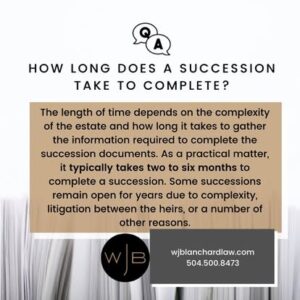
The timeline varies depending on the estate’s complexity and whether there are disputes. Some successions take weeks, others may take months or longer. A succession attorney can help speed up the process when possible.
Yes, certain assets can bypass succession if they’re placed in trusts or have named beneficiaries. Life insurance, IRAs, and retirement accounts often pass directly to heirs. Trusts are also a great way to avoid court involvement.
When there’s no will, Louisiana’s intestate laws decide who inherits. The court follows a specific order based on relationships, which may not reflect what the deceased wanted. That’s why planning ahead matters.
Heirs or beneficiaries can contest a will if they believe it was signed under pressure, wasn’t properly executed, or the person lacked capacity. The court reviews the evidence and decides if the will is valid.
It might be, but Louisiana has unique laws. It’s best to have a Louisiana attorney review your out-of-state will to make sure it holds up here.
The executor manages the estate, pays debts, and distributes property. If there’s no will, the court appoints someone to serve as administrator. Both must follow legal steps and act in the best interest of heirs.
Yes, you’ll likely need one. After the court names you executor or administrator, you can open an estate account to pay bills, collect income, and distribute assets properly.
Succession is usually filed in the parish where the person lived at the time of death. If they lived out of state but owned property in Louisiana, you can file where the property is located.
https://share.google/nV7JR1DZIRYnDzfuI
Read all our Google reviews.
© 2026 WJ Blanchard Law. All Rights Reserved.
